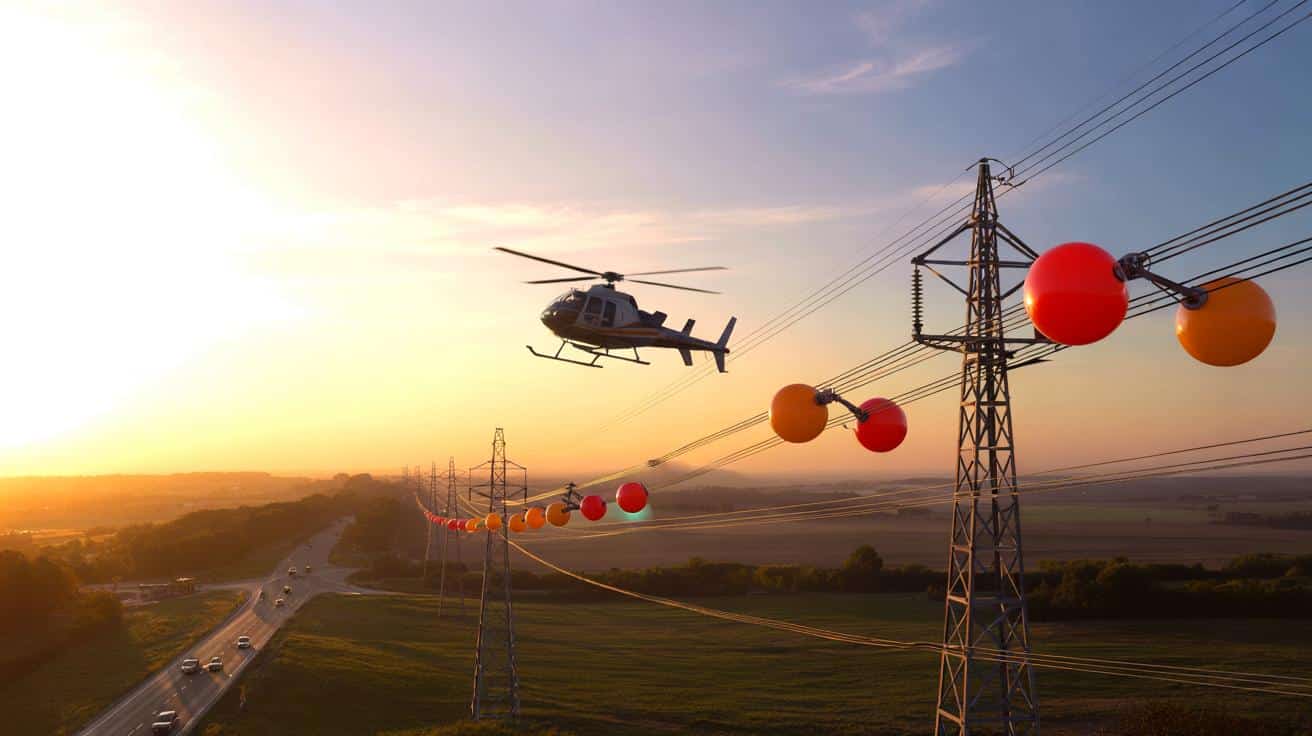
You’re on a road trip, late afternoon, that golden hour where the sky turns soft and the landscape finally relaxes a little. The highway cuts across empty fields, pylons marching along the horizon like giant metal insects. Then you see them: big red balls hanging on the high-voltage lines, spaced out like someone started decorating the sky for Christmas and forgot to stop.
You’ve probably spotted them from a plane window too, little dots hovering above rivers, valleys or highways. They look playful, almost like toys.
But they’re there because something very serious can go very wrong, very fast.
Those red balls aren’t decoration – they’re a warning
Once you notice them, you can’t unsee them. Big red spheres, sometimes orange or white, perched high on the cables of massive power lines. They don’t blink, they don’t move, they just hang there, quietly guarding the airspace.
These are called aerial marker balls, and they’re not there for you and me on the ground. Their main audience lives in the sky: pilots in small planes, helicopters, crop dusters, rescue aircraft. From a cockpit, especially in bad light or tricky weather, a thin metal cable can almost disappear. A bright sphere? Much harder to miss.
Imagine a medical helicopter rushing to a rural accident at dusk. The pilot is flying low, skimming over fields, looking for a safe place to land. The ground is uneven, the light is fading, adrenaline is high. In that blur, the last thing you want is a nearly invisible power line stretched across a valley or a road.
That’s where the red balls come in. They’re placed on sections where aircraft are likely to pass low: near airports, across rivers, over highways, close to hospitals, in mountainous regions. Aviation agencies actually publish maps and rules about these hazard spots. A single collision with a high-voltage line can cut power to thousands of homes, destroy an aircraft, and cost lives in seconds.
From an engineering point of view, the logic is simple. Power lines are long, thin, and often dark, especially against messy backgrounds like forests or hills. Human eyes and brains aren’t wired to catch thin horizontal lines at speed, especially when you’re scanning for a landing zone or following terrain.
So utilities and aviation authorities agreed on a shared visual language: large spheres, high contrast colors, standardized spacing. **Red, orange and white were chosen because they stand out in most landscapes**. The balls don’t protect the wires physically. They simply turn a nearly invisible threat into something the brain can’t easily ignore.
How those red balls are installed – and why you should care where they appear
If you’ve ever stared at them and thought, “Who on earth puts those things up there?”, the answer is: trained line workers and specialized crews, often from helicopters. The method is both spectacular and a bit terrifying to watch. A helicopter hovers close to the live wires, a technician steps out onto a small platform or harness, and the sphere is clamped around the cable in two halves.
➡️ Why old-time gardeners buried a rusty nail at the base of rose bushes
➡️ Why children raised near forests show different brain development patterns
➡️ Thousands of fish nests accidentally found under Antarctic ice
➡️ Which colours make us look older according to psychology?
➡️ With spice from the kitchen : how to drive mice and rats away in winter
Yes, the lines are usually energized. Cutting the power to whole regions every time a marker needs to be placed would be wildly impractical. So teams work with precise procedures, insulated tools and a calmness that frankly feels superhuman.
For people on the ground, the red balls can quietly tell a story about what’s happening above your head. If you spot them crossing a road or a valley, that’s a strong clue that low-flying aircraft pass there on a regular basis. Think rescue helicopters, agricultural flights, sometimes police helicopters.
Walkers, drone pilots, paragliders, even people flying kites or model aircraft often underestimate this shared airspace. We’ve all been there, that moment when a drone shot seems like a harmless game. Then you realize you’re not alone in the sky. A drone tangled in a power line can cause outages, fires, and real legal trouble.
Behind those little red spheres is a set of quiet rules shared by companies and regulators. Power companies must flag potential air hazards on certain spans; aviation standards dictate where and how that should happen. Spacing can vary, but often the balls are set every 30 to 60 meters along the line, with patterns of colors used in long crossings for extra contrast.
Let’s be honest: nobody really reads through the local utility’s safety documents before going out with a drone or a kite. So the balls double as a low-tech, plain-sight safety sign. *If a utility went to the trouble of hanging heavy plastic spheres dozens of meters above the ground, something about that space deserves your attention.*
Reading the landscape: what those red balls can quietly teach you
There’s a small habit you can adopt that changes how you see them. Next time you’re driving or walking and spot those red spheres, pause for a second. Ask yourself: why here? What is being protected in the sky right above this line?
Maybe there’s a small airfield nearby that you never noticed. Perhaps a hospital helipad hidden behind trees. Or a valley that tends to funnel helicopters or light aircraft. Treat the balls like markers on a hidden map, small clues about an invisible layer of traffic overhead.
One common mistake we all fall into: assuming that anything above our heads “belongs to nobody” because we don’t see it used constantly. Teenagers fly kites near high lines, hobbyists launch drones in scenic valleys, hikers send up little cameras for that perfect shot. From the ground, it feels harmless and empty.
Yet those red balls are a gentle reminder that someone, somewhere, calculated a risk for that exact spot. An empathetic way to look at it is this: every sphere up there is a precaution chosen so that a stranger you’ll never meet can land safely, deliver a patient, spread seeds over a field, or search for a missing person.
“From a helicopter, a power line can be practically invisible until the last few seconds,” a rescue pilot once told me. “Those red balls give us just enough warning to change course. They don’t look dramatic, but they save lives.”
- What they’re calledAerial marker balls, line markers or visibility marker spheres.
- What they’re made ofUsually colored plastic or fiberglass, UV-resistant, light but sturdy, clamped around the wire in two shells.
- Where you’ll see them mostOver rivers, ravines, highways, railways, near airports, helipads, industrial zones and busy low-flight routes.
- Who decides to install themPower utilities, guided by aviation safety regulations and local risk assessments.
- What you can doKeep drones, kites and any hobby aircraft far from marked lines, and treat every red ball as a “quiet warning sign” for the sky.
A different way to look at the sky next time you travel
Once you know their story, those red balls stop being random blobs and start to look like punctuation marks in the landscape. They underline a sentence we rarely read: this space is shared, and some of the most dangerous things here are nearly invisible.
They also say something subtle about our infrastructure. Power doesn’t just travel underground in neat cables. It strides across rivers, cuts through forests, floats over our heads on thin metal lines that keep your lights on and your phone charged. The marker balls are the only part of that system that really catches your eye.
Next time you’re in a plane, watch as you descend over suburbs or farmland. You may spot those tiny dots on pylons and crossings, hinting at an invisible conversation between electricity and aviation. Or on a quiet Sunday drive, you might see them over a valley and suddenly picture a helicopter thread its way through that space in the rain.
You don’t need to become an engineer or a pilot to appreciate them. You only need to notice. And maybe tell the kid in the back seat, the drone-flying friend, or the curious neighbor that the sky has its own safety signs, and those red balls are some of the clearest ones we have.
| Key point | Detail | Value for the reader |
|---|---|---|
| Marker balls warn aircraft | They make thin power lines visible to pilots in low or difficult flight conditions | Helps you understand why they appear in specific locations and what risk they signal |
| Placement is highly strategic | Installed over rivers, roads, valleys, near airports and helipads, where low flights are frequent | Teaches you to “read” the landscape and spot hidden air routes or hazards |
| Your behavior matters too | Keeping drones, kites and hobby aircraft away from marked spans reduces accidents and outages | Gives you a concrete way to act safely around high-voltage lines and shared airspace |
FAQ:
- Why are the balls usually red, orange or white?These colors stand out against most landscapes and weather conditions, making power lines easier to spot from the air.
- Do the red balls carry electricity or reduce voltage?No. They don’t change how electricity flows; they’re purely visual markers clipped around the wire.
- Why are there no balls on every high-voltage line?They’re only installed where aircraft are more likely to fly low, such as near airfields, rivers, highways or valleys.
- Can those marker balls fall off or break?They’re designed to be very secure and weather-resistant, but utilities still inspect and replace them during maintenance.
- Is it dangerous to fly a drone under lines with red balls?Yes, it’s risky and often against local rules; you can hit the wires, cause damage, and interfere with critical airspace used by helicopters.