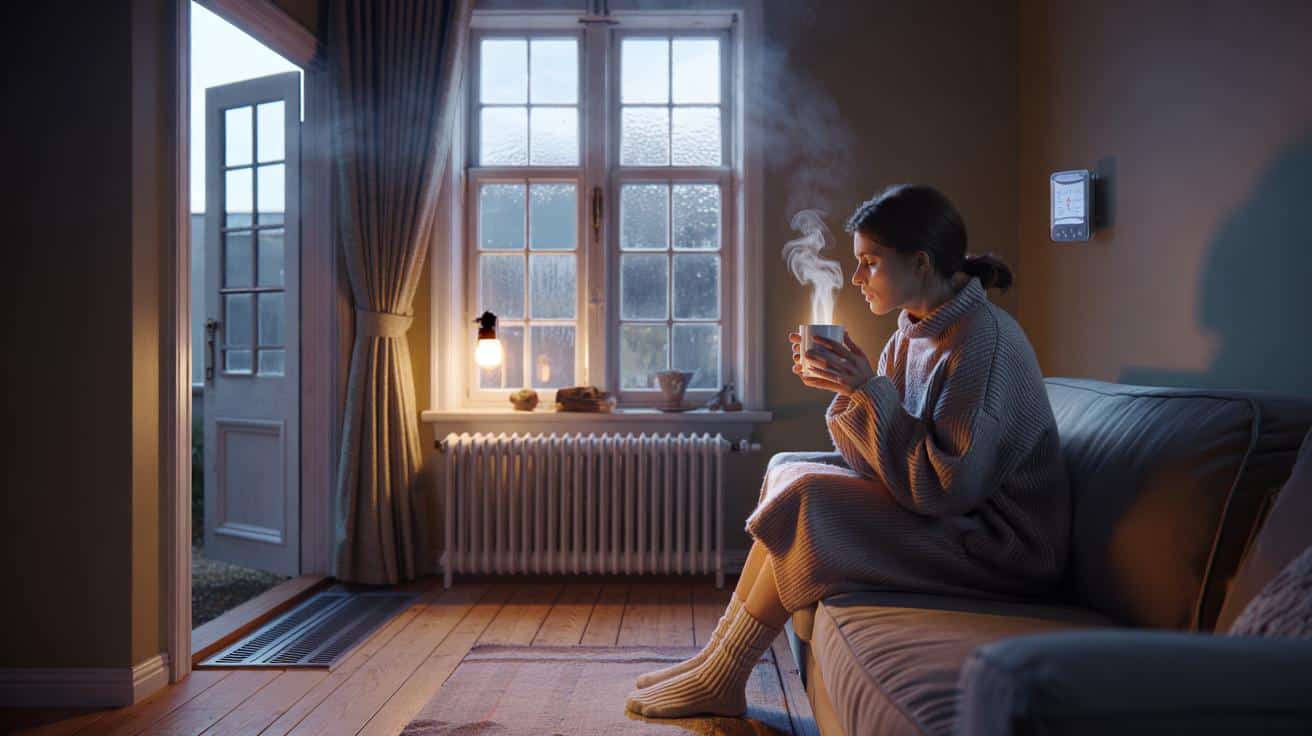
The radiator was ticking, the thermostat said 21°C, and yet Emma sat on her sofa in a wool sweater, shoulders hunched, fingers wrapped around a too-hot mug of tea. The numbers insisted the flat was warm. Her body strongly disagreed. The air felt thin, the floor icy, a faint draught slid along her ankles like a cold cat. She shuffled another blanket over her knees and raised the heating again, feeling guilty as she watched the smart meter jump.
Still cold.
She glanced at the window, at the bare wall behind the sofa, at the uncarpeted floor. Something wasn’t adding up. The room was technically heated.
So why did it feel like winter was still inside the house?
When 21°C on the thermostat still feels like 17°C in your bones
Walk into some homes and the warmth hits you instantly, almost soft around the edges. Walk into others and you get that strange, lukewarm chill: not freezing, not comfortable either, just… stubbornly cold. The thermostat might read the same number in both places. Your body knows which one it prefers.
That’s because our sense of “warmth” isn’t only about air temperature. It’s about surfaces, radiation, air movement and humidity quietly teaming up behind your back.
You can live in a perfectly “heated” home and still feel like you’re sitting in a fridge with the light on.
Your body listens to what the walls say, more than what the thermostat claims.
Think of two friends living on the same street. One is in a 1960s semi with cavity-wall insulation, thick carpets and snug double glazing. The other rents a beautiful old top-floor flat with original single-pane windows, high ceilings and polished wooden floors. Both set their heating to 20°C.
In the semi, you kick off your shoes without thinking. In the flat, you reach for slippers and a hoodie, then secretly bump the thermostat up to 23°C. The energy bill grows, the cold feeling barely shifts.
That gap between number and sensation isn’t imaginary. It’s your body reacting to radiant temperature, draughts and heat loss that the thermostat doesn’t show.
Our skin is incredibly sensitive to the temperature of nearby surfaces. Cold walls, large bare windows and stone floors literally “pull” warmth away from your body by radiation. Your body is warmer than the surfaces, so it sends heat in their direction, and you perceive that as feeling chilled. Air leaks under doors or around window frames create tiny currents that cool the thin layer of warm air around your skin.
So one living room at 20°C can feel cozy, while another at 22°C feels sharp and empty.
This is why a well-insulated small house often feels warmer at lower settings than a draughty, impressive-looking house that swallows heat like a sponge.
Small changes that turn “cold house” into “finally comfortable”
The first lever is not always “turn up the heat”. Often, it’s “slow down the escape routes”. Start with the obvious culprits: gaps under external doors, chimneys, letterboxes, and the edges of old window frames. A simple draught excluder at the door, foam strips around frames, or a chimney balloon can transform how a room feels without touching the thermostat.
Next, look at the floor. Bare tiles or boards broadcast cold straight into your feet. A thick rug can shift the comfort level of a whole room, especially in rentals where structural work isn’t an option.
You’re not just adding warmth. You’re cutting the invisible breeze that keeps stealing it.
Many people unknowingly “fight” their own heating system. Radiators blocked by sofas or long curtains, thermostatic valves hidden behind furniture, doors permanently open so the heat spills into hallways no one uses. The boiler works harder, the house still feels patchy.
Try this: free every radiator so air can circulate around it, then partially close doors to the rooms you use most. Bleed radiators once or twice a year so they heat fully, not just at the bottom.
Let’s be honest: nobody really does this every single day.
Yet that small bit of care once in a while can mean the difference between endlessly nudging the thermostat and actually feeling warm at the same setting.
Sometimes you also have to train your habits, not just your hardware. Layers of soft textiles, warm slippers and throws sound boringly obvious, but they change how your body experiences the exact same air temperature. One person in a T‑shirt at 19°C will shiver. Another, in good socks and a jumper, feels fine and pays less.
We spoke with an energy advisor who put it bluntly: “You don’t heat rooms, you heat people. Your house can lose heat faster than your boiler can provide it, but a sweater and a sealed window can beat that race.”
- Identify draught paths: doors, chimneys, floorboards, window frames.
- Free your radiators: no heavy curtains, no big furniture blocking them.
- Use “zoning” habits: shut doors, heat lived-in rooms first, bedrooms cooler.
- Add textiles: rugs, throws, thicker curtains to cut radiant cold from glass.
- *Listen to your body signals*: cold feet, cold back, cold neck often point to one specific leak.
Rethinking comfort: beyond the number on the thermostat
Once you notice the difference between “air temperature” and “felt warmth”, you can’t unsee it. You start clocking the cold wall behind your bed, the huge window beside your desk, the permanent gap under the front door. You realise your body is in silent negotiation with all these surfaces, all day long.
That changes how you think about comfort. It’s less about forcing the boiler to compensate, more about teaching the house to keep what it already receives.
And suddenly, small, low-tech fixes feel surprisingly powerful.
There’s also something quietly emotional about this. A warm-feeling home is not just a technical achievement, it’s a psychological anchor. You come in, drop your keys, and your shoulders settle without you noticing. In a cold-feeling home, you never really arrive. You hover, pacing between the kettle, the radiator and the thermostat, wondering which one is lying.
Sharing tips with neighbours, checking where others lose heat, swapping stories about “that one room that never warms up” can even become a small form of solidarity in expensive winters.
We’ve all been there, that moment when you question whether it’s the house, the heating, or your own tolerance that’s broken.
➡️ The lazy cleaner’s trick: a few drops in water and windows shine like new until spring
➡️ Why partners who share dreams regularly align visions and support each other’s aspirations
➡️ Your favourite colour says a lot about your personality, according to psychology
➡️ Your favorite color says a lot about you: what color psychology suggests
➡️ Why soaking onions in cold water for 10 minutes changes everything in the kitchen
So if your home feels cold despite “proper” heating, it’s not just in your head, and it’s not necessarily in your wallet either. It might be in the walls, the floor, the windows, the hidden currents of air you don’t see but your skin detects instantly. It might be in the way furniture traps hot air where no one sits, or the way heat quietly deserts the rooms you actually use.
Once you see where the warmth escapes and where your body loses heat to cold surfaces, you can act with more precision and less frustration. That might mean a DIY weekend with draught tape and rugs, a chat with a landlord about glazing, or just rearranging a room so you’re no longer leaning against the coldest wall in the house.
The thermostat will keep showing its number.
The real question is: what does your body say when you walk through the door?
| Key point | Detail | Value for the reader |
|---|---|---|
| Air temperature ≠ felt warmth | Cold surfaces and draughts steal body heat even when the thermostat looks “normal” | Helps explain why some homes feel cold despite adequate heating |
| Fix leaks before raising heat | Seal draughts, free radiators, use zoning and textiles to reduce heat loss | Offers practical ways to feel warmer without huge energy bills |
| Observe your body’s clues | Cold feet, neck or back reveal where surfaces or airflows are failing you | Guides targeted improvements instead of random thermostat changes |
FAQ:
- Why does my house feel colder than my parents’ even at the same temperature?Your building probably loses heat faster because of poorer insulation, single glazing, draughts or large cold surfaces. Your parents’ home may have thicker walls, carpets and better windows, so their surfaces stay warmer and your body feels more comfortable at the same air temperature.
- Is 21°C really the “right” temperature for a home?It’s an average guideline, not a rule. Some people feel fine at 18–19°C with good clothing and low draughts, others prefer 22°C. What matters is a mix of stable temperature, low air movement and warm-enough surfaces, especially floors and walls near where you sit.
- Why are my feet always cold at home even when the heating is on?Cold floors and air circulation near ground level cool your feet faster than the rest of your body. Add rugs, wear insulated socks or slippers and block gaps under doors. If radiators are placed high or only along one wall, the bottom of the room can stay cooler.
- Do thick curtains really make a difference to warmth?Yes, especially on single or older double-glazed windows. They reduce radiant cold from glass and cut draughts around the frame. Just keep curtains above the radiator, not covering it, so you don’t trap heat between fabric and window.
- Should I leave internal doors open or closed for better warmth?For most homes, partially closing doors to rooms you use most keeps heat where you need it and limits circulation into cold hallways or unused spaces. Open-plan layouts are harder to heat, so zoning with doors, screens or even heavy curtains can help concentrate warmth.